What is Hysteroscopy
- Home
- Blogs
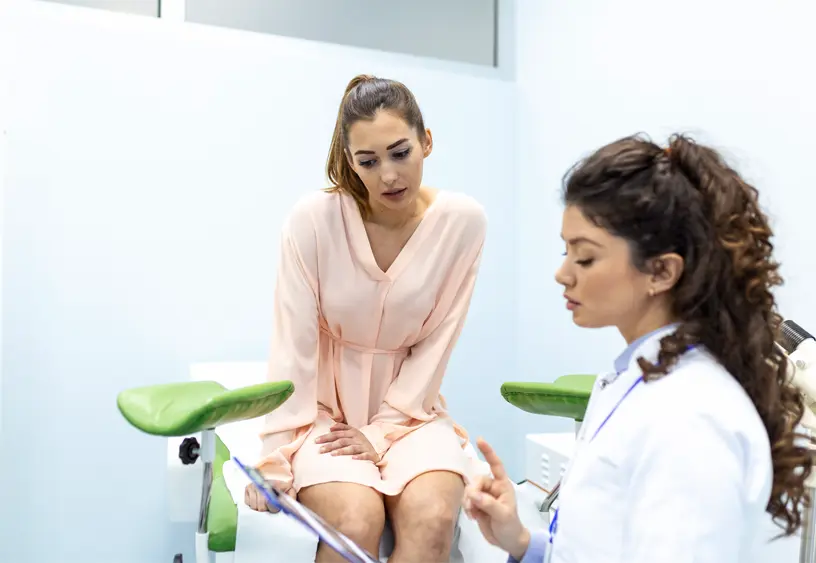
Therefore, your doctor just said that you have a hysteroscopy, and now it is after the middle of the night. You are lying on your bed, scrolling through your phone, trying to make sense of a word you’ve probably never heard before. Sounds familiar? If yes, you are not alone. The majority of women find themselves in this place - with questions, confusion and perhaps a little anxiety. We will simplify this.
Not so long ago it was not easy to diagnose problems within the uterus. Doctors frequently needed to operate by guesswork, or advise surgery simply to understand what was going on inside. Waiting meant uncertainty and in some cases, no clear answers whatsoever. However, nowadays, this is not the case. Doctors are now able to look at precisely what is going on in your uterus - fast, clear and with no major operation.
A hysteroscopy is a test that enables your doctor to examine the inside of your uterus using a thin, flexible tube known as a hysteroscope. It is about the size of a pen, and its tip has both a light and a camera. This device is inserted through the cervix, and the images are displayed on a screen so that your doctor can view everything in real time. There are no cuts, no stitches, and in most cases not even the need for general anaesthesia. The entire process usually takes approximately 10 to 30 minutes, and most women go home the same day.
A hysteroscopy procedure might be recommended if you are experiencing:
To get pregnant, the uterus should be healthy. Even minor problems, such as small uterine polyps or scar tissue, may disrupt implantation. Studies suggest that nearly 40% of infertile women may have a type of uterine abnormality. Many women do not even know they have it. The positive news is that hysteroscopy can not only identify these issues but, in some cases, treat them during the same procedure.
This is done to diagnose the problem. The doctor examines the uterus and decides what further action is needed.
This is a step further. If something unusual is found - such as a polyp or fibroid - it can often be treated at the same time.
When you are advised to undergo a hysteroscopy procedure, it is natural to feel both curious and nervous. The good news is that preparation is usually simple. Your doctor may recommend scheduling it just after your menstrual period for the clearest view of the uterus.
You will lie down like in a routine gynaecological exam. A sterile fluid is used to gently expand the uterus so the doctor can see clearly. Most women feel mild cramping similar to period pain. Pain management options can be discussed in advance if needed.
Recovery after a hysteroscopy is usually quick and uncomplicated.
A hysteroscopy procedure is generally considered low risk. Most women undergo it without complications. Rare risks such as infection or injury occur in less than 1% of cases. Your doctor will explain risks specific to your situation so there is no guesswork.
When you are trying to understand fertility, clarity matters more than assumptions. A hysteroscopy does not treat every condition, but it gives a clear view of what is happening inside the uterus. In many cases, that clarity is the first real step toward effective treatment.
Schedule a consultation with our expert team at MMC IVF. We are here to provide personalized care and support.
MMCIVF and Zivanza Wellness are trademarks and tradenames owned by MUrgency Inc., USA.
Services listed on the MMCIVF.com website are available in each Country we provide services in through MMCIVF Affiliated Clinics licensed, regulated and supervised by the Competent Authorities in the respective Country and based on the applicable laws, rules and regulations in the respective Country / Jurisdiction.
MMCIVF operates Clinics in each Country as aforesaid above under the laws, rules and regulations of the respective Country. All patients / prospective patients / consultees / prospective consultees and / or anyone interacting with MMCIVF Clinics and / or MMCIVF Country Directors and / or MMCIVF Country Doctors and / or MMCIVF Country Nurses and / or MMCIVF Country Staff and / or MMCIVF Country Agents are expected to be fully compliant with the laws, rules and regulations in the respective Country and of any other jurisdiction they (the patients / prospective patients / consultees / prospective consultees and / or anyone interacting with MMCIVF Country and / or MMCIVF Country Directors and / or MMCIVF Country Doctors and / or MMCIVF Country Nurses and / or MMCIVF Country Staff and / or MMCIVF Country Agents) are subject to. MMCIVF Country / MMCIVF Country Directors / MMCIVF Country Doctors / MMCIVF Country Nurses / MMCIVF Country Staff / MMCIVF Country Agents cannot and will not take any responsibility and / or liability for compliance or non-compliance of any law, rule or regulation outside the respective Country where treatment is sought and provided which is solely the responsibility of the patients / prospective patients / consultees / prospective consultees and / or anyone interacting with MMCIVF Country and / or MMCIVF Country Directors and / or MMCIVF Country Doctors and / or MMCIVF Country Nurses and / or MMCIVF Country Staff and / or MMCIVF Country Agents.
Further, MMCIVF Country and / or MMCIVF Country Directors and / or MMCIVF Country Doctors and / or MMCIVF Country Nurses and / or MMCIVF Country Staff and / or MMCIVF Country Agents will not solicit and / or support any family balancing and / or sex determination and / or any prohibited medical procedure in India and / or any prohibited medical treatment in India to Indian Citizens / Residents (whether in India or outside India) strictly following this as MMCIVF Country policy recognizing and respecting applicable Indian Laws, Rules, and Regulations. All Indian Citizens / Residents are advised to ensure that they fully comply with the applicable Indian Laws, Rules, and Regulations while reaching out / interacting / communicating / consulting / taking treatment with MMCIVF Country. MMCIVF Country shall not take any responsibility whatsoever for any violation of any applicable Indian Laws, Rules, and Regulations by any Indian Citizen / Resident while reaching out / interacting / communicating / consulting / taking treatment with MMCIVF Country which sole responsibility shall vest with such Indian Citizens / Residents reaching out / interacting / communicating / consulting / taking treatment with MMCIVF Country. In case any individual / agency / firm / company reaches out to any Indian Citizen / Resident for and on behalf of MMCIVF Country for any family balancing and / or sex determination and / or any prohibited medical procedure in India and / or any prohibited medical treatment in India, please be known that we have not authorized any staff member / individual / agency / firm / company to reach out to Indian Citizens / Residents (whether in India or outside India) to offer and / or support any family balancing and / or sex determination and / or any prohibited medical procedure in India and / or any prohibited medical treatment in India. If you are aware of any such reach outs and / communication, please inform MMCIVF Country at info@mmcivf.ae immediately so that we can take remedial measures against such reach outs claiming to represent MMCIVF Country.
Further, MMCIVF in each Country operates independently and separately from other MMCIVF Clinics in Other Countries.
NOTE: Please read Country as respective Country – USA, Kenya, Georgia and United Arab Emirates as appropriate, relevant and applicable.