Ovarian Hyperstimulation Syndrome (OHSS): Risk Factors, Prevention and What to Watch For
- Home
- Blogs
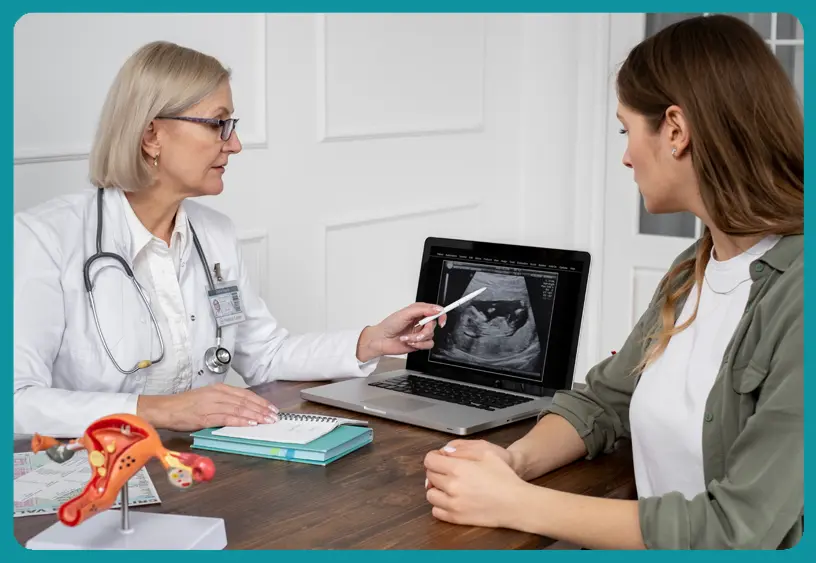
Someone mentions OHSS during your IVF consultation and it's easy to spiral a little before anyone's actually explained what it is. The name alone does most of the damage. In reality it's a known, well-studied side effect of ovarian stimulation, and for most patients it's mild and passes on its own within a week or two. The word "syndrome" makes it sound worse than it usually is.
Once you know what actually causes it, who's more likely to get it, and what your clinic is already doing to keep it from happening in the first place, a lot of the fear just falls away and what's left is something far more manageable — a checklist, basically, not a crisis.
OHSS happens when the ovaries respond more strongly to fertility medication than intended. Instead of a controlled batch of follicles, you get an overresponse — the ovaries swell, and chemicals get released that pull fluid out of the bloodstream and into the abdomen.
Mild cases feel like bloating, some discomfort, a general sense of fullness that won't go away. That's most people. Moderate to severe cases can bring rapid weight gain, vomiting, reduced urination, and in rare situations, real breathing difficulty. Severe OHSS isn't common, and it's precisely why clinics track stimulation cycles as closely as they do — the monitoring exists so it doesn't get that far.
Almost always it traces back to the hCG trigger shot, the injection used to mature the eggs before retrieval. hCG causes the follicles that developed during stimulation to release substances that make blood vessels leakier than normal. More follicles, generally, means a stronger version of this effect.
Which is the useful part, honestly — OHSS tracks pretty closely with how someone's ovaries responded to stimulation in the first place. It's not random. It's dose-related and follicle-count related, and because of that, it's mostly preventable if the protocol's built with the right person's biology in mind from the start.
A few things raise the odds of an overresponse:
None of that means OHSS is guaranteed if any of it applies to you. What it does is tell your fertility specialist which patients need a more carefully built protocol rather than a standard one applied across the board.
This is the part that's changed a lot over the last ten years or so, and it's worth knowing because severe OHSS used to be a bigger concern than it is today.
Some bloating and mild discomfort in the days after retrieval is normal and usually nothing to worry about. What's worth a call to your clinic:
Clinics take these seriously mostly because catching it early is what keeps a mild case from becoming a bigger one.
Yes — mild cases usually resolve with rest, fluids, and being monitored. Moderate cases might need closer outpatient checks. Severe cases, which are rare, sometimes need hospital admission so fluid balance can be managed directly. The main thing is catching it early, which is exactly what a properly monitored protocol is built to do in the first place.
Every stimulation protocol at MMC IVF gets built around the individual patient — ovarian reserve, hormone profile, response history — rather than a standard dose handed out regardless of who's sitting across the desk. For anyone flagged as higher risk for OHSS, that means a tailored trigger approach, closer monitoring through stimulation, and a real plan for freezing embryos where that's the safer call instead of pushing ahead with a fresh transfer anyway.
The goal is getting the eggs you need without taking on risk that didn't need to be there.
OHSS sounds scarier than it usually turns out to be. Most patients get a mild, short version that clears up with basic monitoring at home. The more useful thing to actually hold onto is that modern protocols are built specifically to catch who's at higher risk and adjust for it, which is exactly why the severe version has become genuinely uncommon. Know the warning signs, trust that your clinic's watching for them too, and that's really most of what this topic needs.
Schedule a consultation with our expert team at MMC IVF. We are here to provide personalized care and support.
MMCIVF and Zivanza Wellness are trademarks and tradenames owned by MUrgency Inc., USA.
Services listed on the MMCIVF.com website are available in each Country we provide services in through MMCIVF Affiliated Clinics licensed, regulated and supervised by the Competent Authorities in the respective Country and based on the applicable laws, rules and regulations in the respective Country / Jurisdiction.
MMCIVF operates Clinics in each Country as aforesaid above under the laws, rules and regulations of the respective Country. All patients / prospective patients / consultees / prospective consultees and / or anyone interacting with MMCIVF Clinics and / or MMCIVF Country Directors and / or MMCIVF Country Doctors and / or MMCIVF Country Nurses and / or MMCIVF Country Staff and / or MMCIVF Country Agents are expected to be fully compliant with the laws, rules and regulations in the respective Country and of any other jurisdiction they (the patients / prospective patients / consultees / prospective consultees and / or anyone interacting with MMCIVF Country and / or MMCIVF Country Directors and / or MMCIVF Country Doctors and / or MMCIVF Country Nurses and / or MMCIVF Country Staff and / or MMCIVF Country Agents) are subject to. MMCIVF Country / MMCIVF Country Directors / MMCIVF Country Doctors / MMCIVF Country Nurses / MMCIVF Country Staff / MMCIVF Country Agents cannot and will not take any responsibility and / or liability for compliance or non-compliance of any law, rule or regulation outside the respective Country where treatment is sought and provided which is solely the responsibility of the patients / prospective patients / consultees / prospective consultees and / or anyone interacting with MMCIVF Country and / or MMCIVF Country Directors and / or MMCIVF Country Doctors and / or MMCIVF Country Nurses and / or MMCIVF Country Staff and / or MMCIVF Country Agents.
Further, MMCIVF Country and / or MMCIVF Country Directors and / or MMCIVF Country Doctors and / or MMCIVF Country Nurses and / or MMCIVF Country Staff and / or MMCIVF Country Agents will not solicit and / or support any family balancing and / or sex determination and / or any prohibited medical procedure in India and / or any prohibited medical treatment in India to Indian Citizens / Residents (whether in India or outside India) strictly following this as MMCIVF Country policy recognizing and respecting applicable Indian Laws, Rules, and Regulations. All Indian Citizens / Residents are advised to ensure that they fully comply with the applicable Indian Laws, Rules, and Regulations while reaching out / interacting / communicating / consulting / taking treatment with MMCIVF Country. MMCIVF Country shall not take any responsibility whatsoever for any violation of any applicable Indian Laws, Rules, and Regulations by any Indian Citizen / Resident while reaching out / interacting / communicating / consulting / taking treatment with MMCIVF Country which sole responsibility shall vest with such Indian Citizens / Residents reaching out / interacting / communicating / consulting / taking treatment with MMCIVF Country. In case any individual / agency / firm / company reaches out to any Indian Citizen / Resident for and on behalf of MMCIVF Country for any family balancing and / or sex determination and / or any prohibited medical procedure in India and / or any prohibited medical treatment in India, please be known that we have not authorized any staff member / individual / agency / firm / company to reach out to Indian Citizens / Residents (whether in India or outside India) to offer and / or support any family balancing and / or sex determination and / or any prohibited medical procedure in India and / or any prohibited medical treatment in India. If you are aware of any such reach outs and / communication, please inform MMCIVF Country at info@mmcivf.ae immediately so that we can take remedial measures against such reach outs claiming to represent MMCIVF Country.
Further, MMCIVF in each Country operates independently and separately from other MMCIVF Clinics in Other Countries.
NOTE: Please read Country as respective Country – USA, Kenya, Georgia and United Arab Emirates as appropriate, relevant and applicable.