Endometrial Polyps and Fertility: Small Growths That Can Quietly Block Implantation
- Home
- Blogs
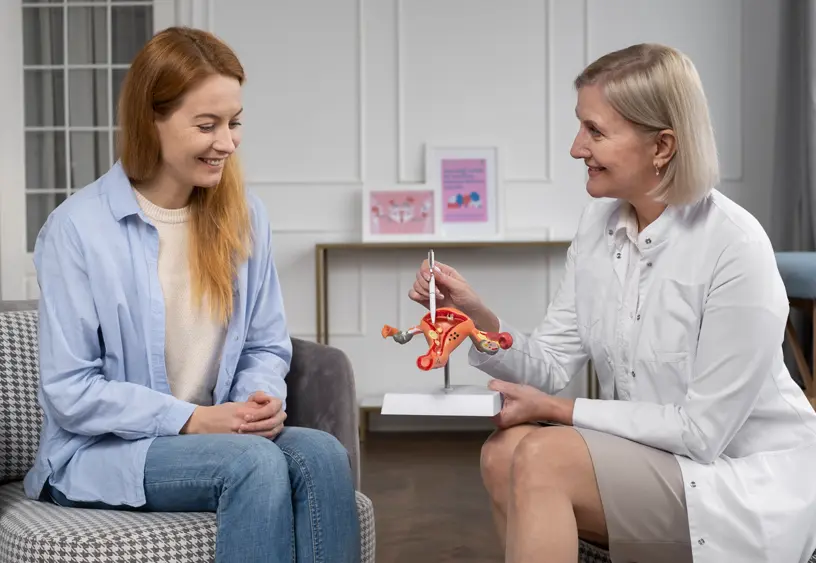
Endometrial polyps are one of the more common findings during a fertility scan and one of the easiest conditions to underestimate. They are small, usually harmless growths that develop in the lining of the uterus (endometrium), often measuring only a few millimetres. Most polyps cause no symptoms, and many women only discover they have one during an ultrasound performed for another reason.
Although they may appear insignificant, endometrial polyps can affect fertility because the uterine lining is where an embryo must implant. A polyp occupying this space can quietly reduce the chances of successful implantation, even when egg quality, embryo quality, and hormone levels are all normal. They are a common and highly treatable cause of unexplained infertility and repeated IVF implantation failure.
This guide is intended for women who have recently been diagnosed with an endometrial polyp or who have experienced unsuccessful embryo transfers without a clear explanation.
An endometrial polyp is a localized overgrowth of the uterine lining. It develops when endometrial glands, connective tissue, and small blood vessels grow together, forming a projection that extends into the uterine cavity. Some polyps grow on a thin stalk, while others remain attached directly to the uterine wall.
Endometrial polyps are relatively common. Studies estimate they occur in approximately 8% to 35% of women overall and in around 15% to 24% of women undergoing fertility investigations. One study involving 1,000 women found polyps in nearly one-third of hysteroscopies performed before IVF treatment.
Most polyps are benign, particularly in women of reproductive age. Their growth is largely influenced by estrogen, which explains why they may enlarge or recur over time. The risk of cancer is very low in younger women and becomes more significant mainly after menopause, particularly when abnormal bleeding is present.
Most endometrial polyps produce no noticeable symptoms, making them easy to miss.
When symptoms do occur, they commonly include:
However, many women experience none of these symptoms. During fertility treatment, polyps are frequently discovered during routine ultrasound examinations or after repeated failed embryo transfers when doctors investigate possible causes of implantation failure.
A polyp may remain inside the uterus for years without causing discomfort while quietly affecting fertility.
Endometrial polyps can interfere with implantation in several different ways, and the effects are not purely mechanical.
Physically, a polyp occupies valuable space within the uterine cavity, potentially preventing an embryo from attaching successfully. Polyps located near the openings of the fallopian tubes (utero-tubal junction) may also interfere with sperm transport or fertilization.
Research has shown that pregnancy rates improve significantly after removing polyps located in this area.
Beyond the physical obstruction, polyps also alter the biological environment of the uterus by:
These biological changes help explain why even relatively small polyps can reduce implantation rates and contribute to recurrent implantation failure.
Most endometrial polyps are first detected during a transvaginal ultrasound, ideally performed during the first half of the menstrual cycle when the uterine lining is thinner.
Because small polyps can sometimes resemble folds in the endometrium or small fibroids, additional investigations may be recommended.
Diagnostic options include:
Hysteroscopy remains the most accurate method for both diagnosis and treatment.
The evidence supporting hysteroscopic polypectomy is encouraging.
During this minimally invasive outpatient procedure, the polyp is removed under direct visualization, making it more precise than older blind curettage techniques.
Research has shown:
Although IVF studies are mainly observational, the overall evidence consistently supports removing polyps before fertility treatment.
Not every endometrial polyp requires immediate treatment.
For women who are not trying to conceive and have no symptoms, small polyps can often be monitored without intervention.
However, recommendations change when fertility treatment is planned.
Most fertility specialists advise removing polyps before:
Current research suggests that even small polyps may negatively affect implantation, and there is no reliable size below which a polyp can safely be ignored.
Timing is also important. A hysteroscopic polypectomy should not be performed immediately before embryo transfer because the uterine lining requires adequate time to heal. The procedure is typically completed during a treatment cycle before the planned embryo transfer.
There are two additional points worth remembering:
Although endometrial polyps are usually benign, they can significantly affect embryo implantation and fertility outcomes. Fortunately, they are among the most treatable causes of unexplained infertility and repeated IVF failure.
If an ultrasound has identified a uterine polyp or you've experienced repeated unsuccessful embryo transfers without a clear explanation, evaluating and treating the uterine lining before your next fertility treatment may improve your chances of success.
Book a consultation with MMC IVF to discuss your fertility assessment and receive a personalized treatment plan designed to optimize your chances of a successful pregnancy.
Schedule a consultation with our expert team at MMC IVF. We are here to provide personalized care and support.
MMCIVF and Zivanza Wellness are trademarks and tradenames owned by MUrgency Inc., USA.
Services listed on the MMCIVF.com website are available in each Country we provide services in through MMCIVF Affiliated Clinics licensed, regulated and supervised by the Competent Authorities in the respective Country and based on the applicable laws, rules and regulations in the respective Country / Jurisdiction.
MMCIVF operates Clinics in each Country as aforesaid above under the laws, rules and regulations of the respective Country. All patients / prospective patients / consultees / prospective consultees and / or anyone interacting with MMCIVF Clinics and / or MMCIVF Country Directors and / or MMCIVF Country Doctors and / or MMCIVF Country Nurses and / or MMCIVF Country Staff and / or MMCIVF Country Agents are expected to be fully compliant with the laws, rules and regulations in the respective Country and of any other jurisdiction they (the patients / prospective patients / consultees / prospective consultees and / or anyone interacting with MMCIVF Country and / or MMCIVF Country Directors and / or MMCIVF Country Doctors and / or MMCIVF Country Nurses and / or MMCIVF Country Staff and / or MMCIVF Country Agents) are subject to. MMCIVF Country / MMCIVF Country Directors / MMCIVF Country Doctors / MMCIVF Country Nurses / MMCIVF Country Staff / MMCIVF Country Agents cannot and will not take any responsibility and / or liability for compliance or non-compliance of any law, rule or regulation outside the respective Country where treatment is sought and provided which is solely the responsibility of the patients / prospective patients / consultees / prospective consultees and / or anyone interacting with MMCIVF Country and / or MMCIVF Country Directors and / or MMCIVF Country Doctors and / or MMCIVF Country Nurses and / or MMCIVF Country Staff and / or MMCIVF Country Agents.
Further, MMCIVF Country and / or MMCIVF Country Directors and / or MMCIVF Country Doctors and / or MMCIVF Country Nurses and / or MMCIVF Country Staff and / or MMCIVF Country Agents will not solicit and / or support any family balancing and / or sex determination and / or any prohibited medical procedure in India and / or any prohibited medical treatment in India to Indian Citizens / Residents (whether in India or outside India) strictly following this as MMCIVF Country policy recognizing and respecting applicable Indian Laws, Rules, and Regulations. All Indian Citizens / Residents are advised to ensure that they fully comply with the applicable Indian Laws, Rules, and Regulations while reaching out / interacting / communicating / consulting / taking treatment with MMCIVF Country. MMCIVF Country shall not take any responsibility whatsoever for any violation of any applicable Indian Laws, Rules, and Regulations by any Indian Citizen / Resident while reaching out / interacting / communicating / consulting / taking treatment with MMCIVF Country which sole responsibility shall vest with such Indian Citizens / Residents reaching out / interacting / communicating / consulting / taking treatment with MMCIVF Country. In case any individual / agency / firm / company reaches out to any Indian Citizen / Resident for and on behalf of MMCIVF Country for any family balancing and / or sex determination and / or any prohibited medical procedure in India and / or any prohibited medical treatment in India, please be known that we have not authorized any staff member / individual / agency / firm / company to reach out to Indian Citizens / Residents (whether in India or outside India) to offer and / or support any family balancing and / or sex determination and / or any prohibited medical procedure in India and / or any prohibited medical treatment in India. If you are aware of any such reach outs and / communication, please inform MMCIVF Country at info@mmcivf.ae immediately so that we can take remedial measures against such reach outs claiming to represent MMCIVF Country.
Further, MMCIVF in each Country operates independently and separately from other MMCIVF Clinics in Other Countries.
NOTE: Please read Country as respective Country – USA, Kenya, Georgia and United Arab Emirates as appropriate, relevant and applicable.